
A dummies guide to the math of AI
Before you begin your journey in Machine Learning(ML) and Deep Learning (DL) you should at least know the basic math behind what you will be doing. Although you can still dive right into algorithms and implementation of code you will have a severe handicap against your data science peers.
Everyone is at some level daunted by math. But once you understand its real world application to data science, it becomes inherently more fun and useful.

The mathematics for machine learning can be divided into 3 main categories:
- Linear Algebra
- Calculus
- Statistics and Probability
Linear Algebra
Question: Why study linear algebra?
Answer: By using linear algebra we can solve “linear equations”. Linear equations can be represented in the forms of matrices. A matrix in machine learning is how we represent our features. We can represent data in 0 dimension (scalar), 1 dimension (vector), 2 dimensions (matrix) and n-dimensions (tensor).
A simple linear equation is y = wx + b
where;
y = y-axis, x = x-axis, w = slope, b = y-intercept
However in machine learning;
y = prediction, b= bias, w = weight of feature, x = feature
Question: Why do we need to study logarithms?
Answer: In machine learning you will have to deal with big data (millions of rows and countless features). Logs help us express large numbers efficiently. And most importantly they will help us solve exponential equations like sigmoid (know as activation function in deep learning). After studying linear algebra you will learn how to solve linear equations, represent your data in dimensions and understand logarithms.
Tutorials
For beginners (high school math only): Start with this tutorial.
For intermediate (college level math only): Start with this tutorial.
Fun fact: The world algebra comes from Muḥammad ibn Mūsā al-Khwārizmī (ca. 750–ca. 850) who used it to solve linear and quadratic equations.
Calculus
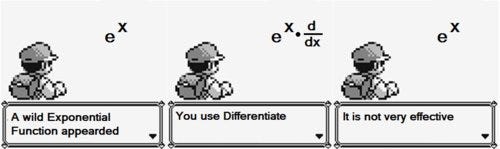
Calculus tell us how things change. In machine learning we make predictions and calculus helps us make them. In calculus you will need to study derivatives, partial derivatives, gradients and chain rules.
Question: Why study derivatives?
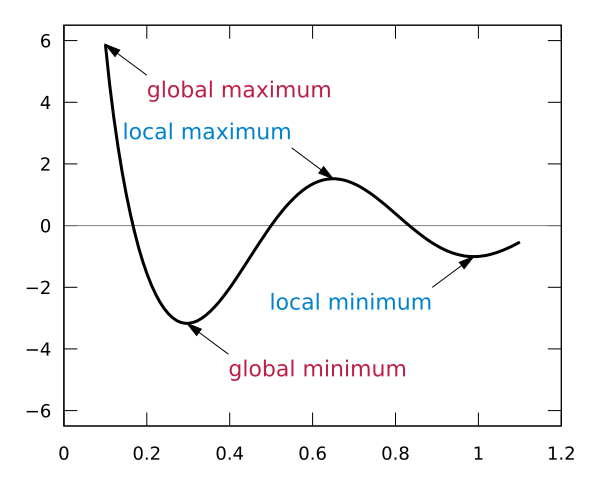
Answer: A derivative simply shows the rate of change; the amount by which a function is changing at one given point. In machine learning we will need to find the minimum point in our function where the prediction we make is the optimal. Derivatives help us do that. Partial derivatives are a very similar to derivatives as well.
Question: Why study gradients?
Answer: A gradient is simply the slope of a graph. In machine learning we use a powerful optimization technique called gradient descent known as backpropagation in deep learning. Gradient descent is simple terms help us to find the local minima which reduces our prediction error.
Great visual tutorial on backpropagation can be found here.
Tutorials
For beginners (high school math only): Start with this tutorial
For intermediate (college level math only): Start with this tutorial
Fun fact: Isaac Newton and Gottfried Leibniz independently discovered calculus in the mid-17th century. Both died disputing who came up with it first.
Statistic and Probability
In machine learning in any type of problem either regression on classification your algorithm will compute a probability from the features. In order to interpret what the accuracy means we will need to study stats and probability.
Question: Why study statistics?
Answer: Stats is a powerful tool for data scientists; you will learn how to analyze data and visualize data. Stats is mainly used in the data preprocessing stage.
Types of variables:
Discrete variables: Variables which can be counted (e.g. number of lions)
Continuous variables: Variables which can be measured (e.g. height,weight)
Question: Why use summary statistics?
Answer: So we can quickly summarize the most important points of our data. Summary statistics includes; central tendency, mean, median, mode, standard deviation, skewness, kurtosis, range, interquartile range and charts (histogram, scatter plot, pie chart, line chart etc.)
Central Tendency: Describes the central tendency of a data via mean, median, mode
Mean: Sum of all observations/ number of observations
Median: The middle observation
Mode: The most common observation
Range: All respective observations in a group
Interquartile Range: Range of observations largest to smallest
Variance: Squared difference of observation from mean / number of observation
Standard deviation: Square root of variance.
Question: Why is Standard deviaton so important?
Answer: We use standard deviation to measure how our data is distributed. The greater the spread the greater the standard deviation.
Hypothesis testing: In data science, you always start with a hypothesis. Your goal is to reject the null hypothesis.
Types of Error 1&2:
 Type 2 errors are more dangerous than Type 1 errors
Skewness: Measure the lack of symmetry in our data. Symeetrical data will have perfect symmetry on both sides.
Kurtosis: Measure whether the data are heavy-tailed or light-tailed relative to a normal distribution.
Normal distribution: Values plotted on a graph which are bell shaped. Great primer on normal distribution and its importance can be found here.
If data looks normal use = z, t, ANOVA, Chi, F test
If data is skewed use = Chi, F test
Question: Why use Probability?
Answer: Probability simply means chance of an event happening. We use the range of 0 – 100% to describe the chance of a particular event happening. 0 being no chance, 100 being an absolute.
Conditional Probability: Simply means the chance of an A event happening, if event B has already happened.
Tutorials
For beginners (high school math only): Start with this tutorial.
For intermediate (college level math only): Start with this tutorial.
Fun Fact: Al-Kindi developed the first code breaking algorithm based on frequency analysis.