Is there a limit to science?
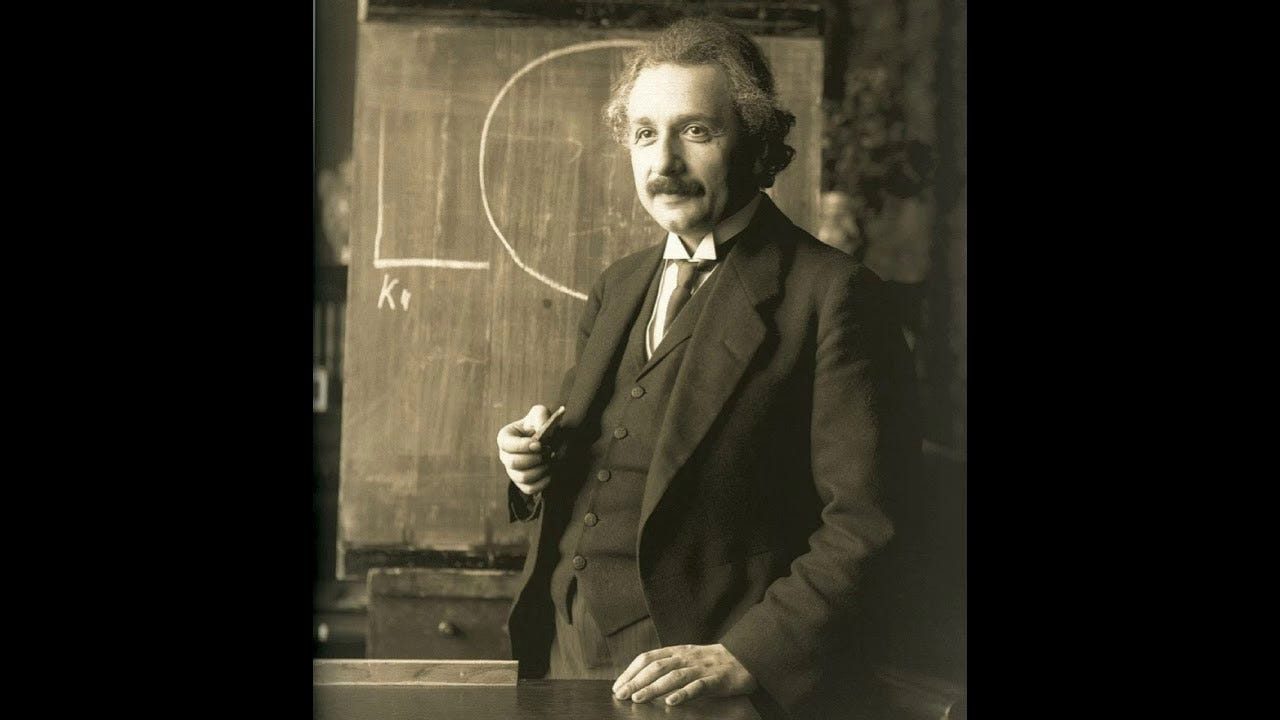 Albert Einstein during a lecture in Vienna in 1921
Arguably, the single most important invention devised by the human civilization is the “scientific method”.
All our technological prowess and understanding of nature can be attributed solely to it.
This simple method based on deduction, inference and induction has been the biggest boon for our species.
*“The real purpose of the scientific method is to make sure nature hasn’t misled you into thinking you know something you actually don’t know.” — *Robert M. Pirsig
What is the scientific method?
- Observation: The first step is observation of a phenomena.
- Question: After observing we formulate a question corresponding to our observation.
- Hypothesis: Propose a hypothesis to the question. A hypothesis is a potential answer to the question.
- Prediction: Predicting the output of the hypothesis.
- Testing: Testing the prediction by carrying out experiments. Testing may support or oppose the predictions.
- Reproducibility: Your results need to be reproducible for everyone.
Note: The scientific method is an iterative process that can be viewed as a feedback-loop. You can go to Step 1 at any point. The scientific method can be used to prove or disprove your hypothesis.
Limits of the scientific method
In January 2018, Neil deGrasse Tyson came on The Late Show and told Stephen Colbert what keeps him up at night. Talking about dark energy he said:
“ So this dark energy in the future will render the universe so large having accelerated so significantly that all the galaxies of the night sky would have accelerated beyond our horizon and all the galaxies are the source of our knowledge of cosmology, of the big bang, everything we know about the history of the universe comes to us form these galaxies, if they accelerate beyond our horizon the next generation of cosmic explorers will only have the stars of the milky way to think about. There would have been an entire chapter of the universe ripped from their view and they would be trying to contemplate an understanding of the universe without a significant part of what its past was . So I lose sleep wondering today was there some previous chapter ripped from the universe itself and here we are touching the elephant not knowing that in fact there is an elephant standing there or maybe there’s the shadow of the elephant and the elephant has been moved. We dont know, what we dont know. And this leaves me awake at night. I loose sleep over that”.
So hypothesis must be testable, falsifiable and repeatable.
So, if you cannot observe it, how can you prove or disprove it?
Can we know something which cannot be known?
As of now, we as humans do not have a solution to this problem. Of course we have philosophy to ponder over these questions but philosophy does not offer any quantifiable proofs.
We must simply resign to the fact that we simply dont know, what we dont know.
But there is comfort to be found in the words of Sir Bertrand Russell:
“Science may set limits to knowledge, but should not set limits to imagination.”