Pakistan: The story of a rapidly failing state
Introduction
Pakistan for the uninitiated is a nuclear-nation and the fifth-largest country in the world by population. Over 210 million people live in an area slightly less than twice the size of California. Pakistan since its inception has been marred with a turbulent history of dynastic family politics, military dictatorships, debilitating feudalism, a self-serving bureaucracy, burgeoning radicalization and a lack of social ethos verging on moral bankruptcy. Pakistan ranks 17th on the Fragile States Index (FSI). Fragile State being just a polite nomenclature for; a Failed State.
A Failed Vision
Pakistan’s founding father was Muhammad Ali Jinnah, a well educated secular-Muslim lawyer of Indian Subcontinent. Jinnah envisioned Pakistan to be a secular democracy and expressed this desire in his first Presidential Address to the Constituent Assembly of Pakistan in August 11, 1947:
“You are free, you are free to go to your temples, you are free to go to your mosques or any other place of worship in this State of Pakistan. You may belong to any religion or cast or creed — that has nothing to do with the business of the State … Now I think we should keep that in front of us as our ideal and you will find that in course of time Hindus would cease to be Hindus and Muslims would cease to be Muslims, not in the religious sense, because that is the personal faith of each individual, but in the political sense as citizens of the State”
But Jinnah’s dream never materialized, his secular vision was derailed by the adoption of the Objectives Resolution in 1949. Pakistan’s biggest hurdle in joining the developed world has been its failure to develop a societal consensus or more aptly a social contract. The dilemma of Pakistan has been a dichotomy of Jinnah’s progressive secular vision versus society’s maturing myopic ideological doctrine.
A Radical Identity
In 1977, General Zia-ul-Haq executed the third successful military coup and shortly thereafter hanged the only rival to his power prime minister Zulfikar Ali Bhutto. A prop to consolidate power, Zia’s central reformation policy was “Sharization”. Historically, religion has been a tried and tested tool for rulers. In 1977, Zia implemented the Hudood Ordinances which enacted ban on alcohol, unlawful fornication, strict blasphemy laws, profit-loss banking, Zakat tax, Ramadan Ordinance and established the Federal Shariat Court and a Shariat Appellate Bench on the Supreme Court. To this day the Shariah-courts run in parallel with traditional court system, ensuring the inextricable marriage between religion and state for all times to come.
After Zia’s power-grab, countless religious groups advocating the establishment of ISIS-style global caliphate, expanded their foothold in Pakistan. Within 10 years, from 1977 till Zia’s death in 1988, Pakistan’s society transformed from an Islamic state (with secular undertones) to a semi-Shariah theocracy. Pakistan is still reeling from Zia’s policies, a culture of hypocrisy has taken deep roots in the underbelly of society. Secular and moderate Pakistanis refuse to criticize their radicalized peers due to a well documented track-record of violent retribution.
However, Zia was not the sole contributor of Pakistan’s radicalized identity. In 1979, The United States of America poured in billion of dollars for Pakistan to setup Jihadi camps for a proxy war with the Soviet Union in Afghanistan. After the Russians were expelled from Afghanistan, Pakistan army continued to foster Jihadi organizations against its long-time rival India but in the process created insurmountable problems for the State.
To further compound the woes of the Muslim world, since the 70’s Saudi Arabia has spent $100 billion dollars to export its Wahabi-Salafi-ideology in Muslim countries like Pakistan. In 1947, there were 189 madrasas (religious schools) in Pakistan, in 1956 around 244 and today there are over 40,000 plus madrasas all over the country. These madrasas have been a fodder to terrorist groups within the country. After 9/11, Pakistan Army’s own home grown Jihadi networks turned against the state for its failure in transitioning to a fully-fledged Islamic Caliphate. It wasn’t until Operation Zarb-e-Azb and heavy military and civilian casualties that Pakistan recovered from pervasive home-grown terrorism. This goes to show like fire, you can feed an ideology but never control it.
A False Democracy
It would be an exercise in naivety to think that external forces do not manipulate the sociopolitical climate within Pakistan. But nations like individuals, will always safeguard their national interests, it would be foolish to think otherwise. However, it would be an exercise in self-deception, if all of Pakistan’s failures were attributed to external actors only (as portrayed by the media).
In order to understand the failures of Pakistan we have to first examine the ground realities: Pakistan does not enjoy true democracy but a quasi-democracy, as it has two centers of power; Government and Army. The perpetual tussle between civil-military apparatus has contributed immensely to Pakistan’s instability.
It can be argued that the third rising power-center in the country is the Judiciary. Historically Pakistan’s Judiciary has played second-fiddle to the government but recent corruption allegations against the siting government and support from the Amy has caused the Judiciary to finally flex its muscles.
Pakistan Army has enjoyed power since the first military coup of Ayub Khan in
- Since 1958, there have been a total of four military coups. After the ousting of Perez Musharraf in 2008, Pakistan resumed its quasi-democracy experiment. Army still influences internal/external policies because it is the most organized institution in the country and due to the moral bankruptcy of Pakistani politicians. Another bane for Pakistan is corruption. Corruption runs rampant in all segments of the Pakistani society. According to Transparency International’s global Corruption Perceptions Index (CPI) Pakistan is ranked 117th out of the total 180 countries. Corruption follows a top-down approach and for this reason corruption has trickled down from the elites to the masses.
A Broken Economoy
What makes Pakistan weak is not just division between its institutions but also its dire economic conditions. Foreign influence continues to plague internal policies because of Pakistan’s heavy reliance on foreign aid.
Debt is modern day slavery.
As of May 2018, Pakistan’s external debt and liabilities stand at $89 billion. At such massive debt levels and only $11 billion in foreign currency reserves the Pak Rupee continues to devalue against the US Dollar. This makes imports expensive and exports cheaper. However Pakistan imports more than it exports, to be precise $30 billion more. In other words, Pakistan spends $30 billion more than it earns. Just to pay off debts for 2018–2019 the country will further borrow Rs 1.55 trillion from the domestic market and Rs 342.1 billion from foreign countries. The need for payment of outstanding debts is quite straightforward; if Pakistan does not meet its payment obligations all import and exports will cease and the country will descent into chaos and anarchy.
Pakistan essentially runs like a Ponzi scheme, in order to survive it keeps on borrowing to pay off the money it has already borrowed. Pakistan is collectively owned not by its citizens but by its debtors. This ensures subservience and placation by the Pakistan’s civil-military apparatus to US, EU and Chinese interests. However, Pakistan’s debt woes are not its only problem. The nation is incapable of regulating the undocumented economy (black economy) and implement effective taxation policies.
According to Bloomberg report in 2012 , 36% of Pakistan’s economy is unregulated which roughly equals to $100 billion. Also only 25% of the visible economy is taxed.
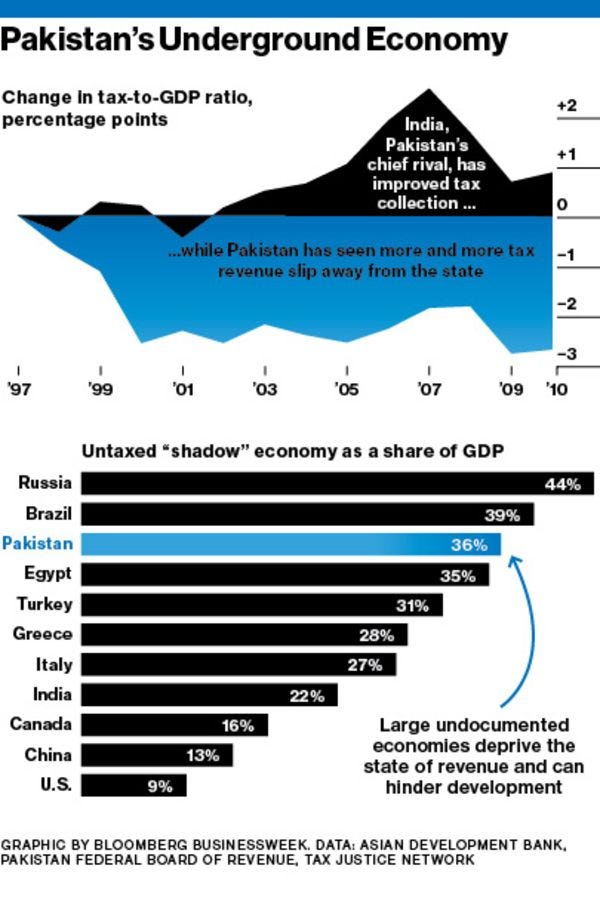
According to the International Development Committee only 0.57% of the population file tax returns which is roughly 1.1 million out 210 million people. IMF reports Pakistan looses Rs. 3.3 trillion or $ 2.8 billion each year in revenue due to failure of tax collection. This robs exchequer of billions of dollars in revenue each year which could be leveraged to pay off debts, build foreign currency reserves and reject the need for lopsided trade deals.
Conclusion
Pakistan is a country in the cross-hairs of myriad challenges, mostly homegrown. Pakistan is a failing state because the interests of the powers at be are in direct conflict with the interests of the nation. In Pakistan the military tends to perpetuate power and the civilian government tends to amass wealth in their political term rather than solve Pakistan’s systemic socioeconomic issues. Pakistani politicians are essentially businessman disguised as political leaders.
Hypocrisy is the glue that binds morally bankrupt societies and Pakistan is no exception. Pakistan is a rapidly failing state and its failures are entirely its own.