
Why Are We Irrational?
What is Irrationality?
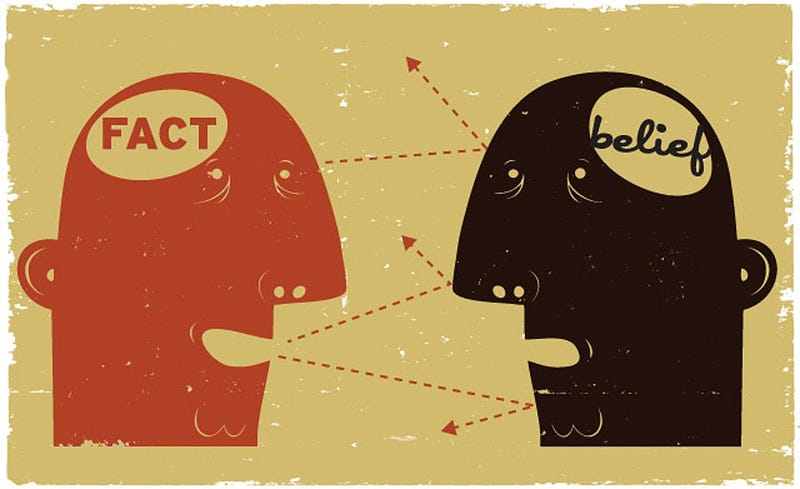
Irrationality is emotion disguised as reason.
The scientific method in my opinion, is the single greatest invention devised by humanity. The scientific method simply states “Belief is contingent upon observation”. This simple yet powerful concept is responsible for all our technological advancement, our understanding of the universe, the nature of reality and is the basis of the philosophy of the hard sciences.
Science has allowed us to live longer, travel faster, communicate instantly over long distances and has allowed us to harness the forces of nature. Science is not an ideology, it is just a tool, a tool used to understand, predict and measure the laws of nature. Thankfully, our universe adheres to laws which can be measured like gravity, electromagnetism, strong and weak nuclear forces. Tomorrow, if for some reason, the speed of light changes from 299,792,458 m/s to 300,000,000 m/s, we will measure it, update or discard our old theories. Since science uses an “Evidence based approach”, if the evidence changes, science changes, it is as simple as that.
Although, science continues to increase and improve our lives we are still very much anti-Science. A lot of people believe the earth is flat, vaccines are harmful, evolution is a lie, climate change is a hoax and the earth is 10,000 years old. Yet these same people use high-speed internet, smartphones, laptops, cars and medicine — the irony!
Are these people clinically insane? No at all. Most people who believe in unsubstantiated beliefs are highly educated these people are doctors, engineers, politicians and even scientists. The belief in unproven beliefs relies on the emotional cognitive paradigm which seems to be paradoxically compatible with the rational paradigm of our reasoning.
The human brain is paradoxical in nature; it can hold a multitude of contradictory thoughts in perfect harmony and justify every action it makes without any conundrum. This amazing feat is achieved due to a cognitive bias psychologists call cognitive dissonance.** **But cognitive dissonance is not the only bias that plagues our thinking. A plethora of an exhaustive list of cognitive biases inflict us all on a daily basis.
We are in fact just; sum of all of our cognitive biases.
Biases are formed when our emotional brain justifies and rationalizes behavior or reasoning with the parts that govern logic. Cognitive biases keep us from accepting reality. The ability to change one’s mind when presented with facts is rarer than people think. We actually get more stubborn when our beliefs are challenged by facts contrary to our opinion. This is called the backfire effect. If any new evidence, however illogical is brought up supporting our beliefs, our beliefs get stronger, this is called confirmation bias. This means that our default mode of thinking is unscientific. We have preexisting beliefs and we look for cues to further strengthen them.
“Beliefs can survive potent logical or empirical challenges. They can survive and even be bolstered by evidence that most uncommitted observers would agree logically demands some weakening of such beliefs. They can even survive the total destruction of their original evidential bases.”
Lee Ross and Craig Anderson
Our brains have not evolved for scientific thinking but for survival thinking. Thinking is taxing on our brain, so it is easier to copy ideas rather than question or create new ones. Human beings are extremely tribal by nature as most of our collective evolution happened in tribes of a few hundred people. This is further corroborated by the Dunbar number attributed to British anthropologist Robin Dunbar. The Dunbar number states that humans can establish only 150 stable relationships in a lifetime. Living in tribes meant establishment of herd mentality or herd behavior. This explains the bandwagon effect*, **it is genetically advantageous to follow the herd than go against it. Humans social hierarchy is closely related to the social hierarchy of the great apes. We are evolutionary programmed to follow the alpha of the group and this subservience to authority is reflected in the *Milgram experiment. *The Milgram experiment unveils our innate obedience to authority figures also know as *authority bias.
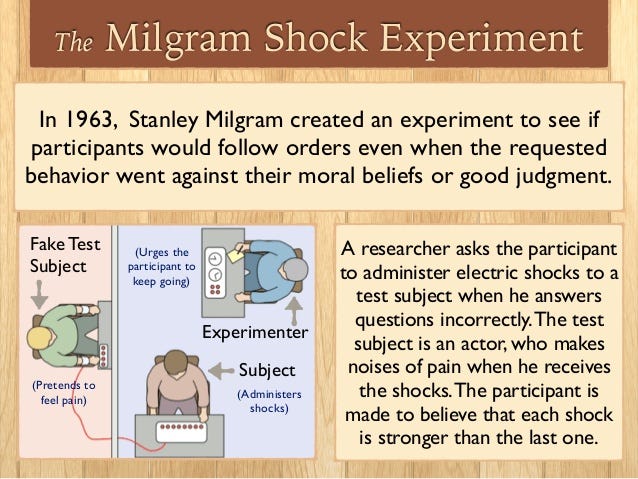
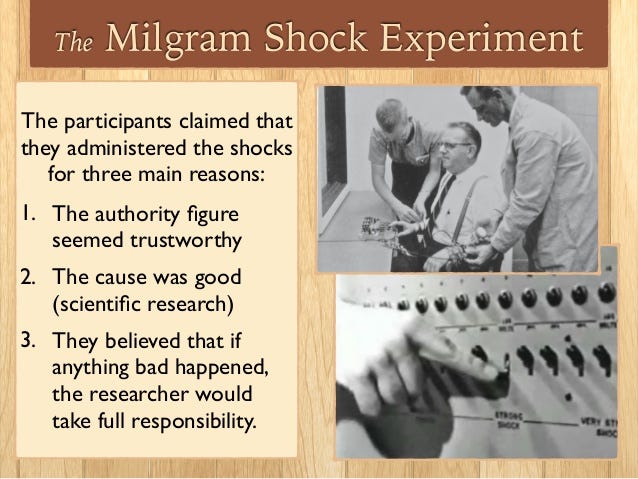
In the end of the experiment, Stanley Milgram concluded that ordinary people are likely to follow orders from authority figures which can result in the death of an innocent person.
Fear is a powerful opponent of reason and it seems it may be the seat of our irrational behaviors. We are conditioned from a young age to mimic the beliefs our parents and the failure to do so would mean alienation of unconditional love. A conflict with the beliefs of our family and of our tribe meant expulsion from the tribe, rejection by mates and zero mating opportunity. The lack of reproduction would mean the genetic death of such person, as no genes would be passed on. As we get older we actually get increasingly hostile to people who challenge our beliefs because they oppose, question and doubt our world view. By challenging our beliefs they threaten our place in the tribe. This is known as* hostile attribution bias*.
It seems we humans are more emotion-driven and less less-logic driven than we are led to believe. We conform for survival and reject science infused logic if it contradicts with our tribe. We want to be certain about things even when there is a lack of evidence because certainty provides comfort and uncertainty causes existential anxiety. This is why I contend, that as a species, we are still in the infantile stage of both our cognitive and social evolution.